
Your employees are sweating through their shirts. Your thermostat reads 78°F even though the AC has been running all morning. And the repair company you just called has a three-day wait.
Sound familiar? For Indianapolis business owners, a rooftop unit failure isn’t just uncomfortable — it’s a business disruption that hits your bottom line fast. The good news: most RTU breakdowns are preventable. What stands between you and an emergency shutdown is a regular commercial RTU maintenance schedule.
Here’s everything you need to know about commercial RTU maintenance in Indianapolis — including what it covers, how often to schedule it, and the warning signs most business owners miss until it’s too late.
What Is a Rooftop Unit — and Why Should You Care?
A rooftop unit, or RTU, is a self-contained HVAC system mounted directly on your building’s roof. It handles heating, cooling, and ventilation all in one package. You’ve probably seen them on top of strip malls, medical offices, restaurants, and warehouses — they’re one of the most common commercial HVAC setups in Central Indiana.
RTUs are designed for durability. A well-maintained unit lasts 15 to 20 years. Skip the maintenance, and that number drops to 10 to 12 years — sometimes less. In a city like Indianapolis, where summer heat indexes regularly exceed 95°F and January temperatures can plunge below zero, your building’s HVAC system is working hard year-round. That kind of stress accelerates wear on every component.
If you own or lease commercial space and your building has an RTU, its performance directly affects your employees’ comfort, your energy bill, and your ability to keep the doors open.
The Real Cost of Skipping RTU Maintenance
It’s tempting to skip maintenance when things seem to be running fine. Why pay for a service call when nothing’s broken?
Here’s why that logic doesn’t hold up.
Energy waste adds up fast. A neglected RTU — one with dirty coils, a clogged filter, or low refrigerant — can use 20 to 30% more energy than a properly maintained unit. For a business running its system 10–12 hours a day, that’s a noticeable spike in your monthly utility bill. Over a year, it can add up to hundreds or even thousands of dollars in unnecessary costs.
Emergency service costs more. When an RTU breaks down unexpectedly, you’re not just paying for parts — you’re paying emergency HVAC service calls rates, which typically run 2 to 3 times the cost of a scheduled maintenance visit. You’re also dealing with the disruption: missed appointments, uncomfortable customers, and employees who can’t focus.
Replacements are expensive. Commercial HVAC installation and replacement in Indianapolis typically runs $7,000 to $15,000 or more, depending on unit size and complexity. For an exact quote, contact Raymoore for a quote. A preventive maintenance plan costs a fraction of that annually. The math is simple: preventive maintenance is the cheaper path, every time.
And for businesses in food service or healthcare, there’s another layer of risk. A failed HVAC system can trigger health code issues, put your license at risk, and force a temporary closure. That’s not a fine — that’s your reputation.
What a Commercial RTU Maintenance Visit Actually Covers
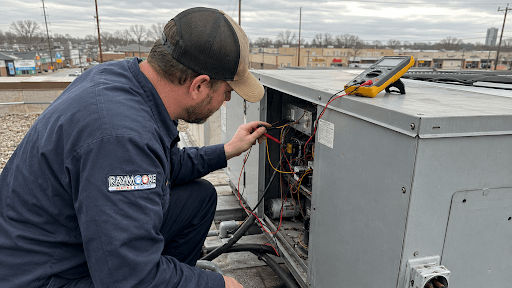
Not all HVAC maintenance is equal. A thorough commercial RTU maintenance visit goes far beyond swapping out a filter. Here’s what a qualified technician should cover across all commercial HVAC services on every visit:
- Air filter inspection and replacement — dirty filters restrict airflow and make your system work harder
- Coil cleaning — both evaporator and condenser coils collect grime that reduces heat transfer efficiency
- Refrigerant check — low refrigerant is a common cause of reduced cooling and compressor damage
- Belt, bearing, and motor inspection — worn components cause noise, vibration, and eventual failure
- Electrical connection inspection — loose or corroded connections are a fire and failure risk
- Capacitor testing — capacitors fail more often than most people realize, and early detection prevents compressor damage
- Thermostat calibration — a miscalibrated thermostat causes short-cycling and temperature swings
- Condensate drain line clearing — a blocked drain line causes water damage and mold growth
- Heating element testing — heat strips or gas burners need to be verified before winter arrives
- Performance data logging — tracking readings over time helps catch declining trends before they become failures
When Raymoore Heating and Cooling performs commercial RTU maintenance, you get Carrier®-certified technicians who know these systems inside and out. Every visit includes a written service report so you have documentation of what was done — useful for lease compliance, insurance purposes, or simply peace of mind.
Is your RTU ready for Indianapolis’s next heat wave?
Raymoore has been keeping Central Indiana businesses comfortable since 1999. Our commercial maintenance visits are thorough, documented, and we work to schedule them around your business hours.
How Often Should Indianapolis Businesses Schedule RTU Maintenance?
The short answer: at least twice a year.
Indianapolis sits in a climate zone that swings hard in both directions. Summers bring humidity levels consistently above 70% in peak months and heat indexes that regularly exceed 95°F. Winters regularly bring temperatures below 0°F with wind chills that drive them lower. Your RTU has to handle both extremes, and that demands a biannual maintenance schedule at minimum.
Here’s a simple framework:
- Pre-cooling season (April or early May): Prepare your system for summer cooling demand — clean coils, check refrigerant, verify controls.
- Pre-heating season (September or October): Test heating elements, inspect burners, check belts and bearings before the cold hits.
For businesses with higher-than-average HVAC demand — restaurants, gyms, medical offices, and manufacturing facilities — quarterly checks make sense. These environments push systems harder and can’t afford unexpected downtime.
The easiest way to stay on schedule? A maintenance agreement with Raymoore. We handle the scheduling so you don’t have to remember. Your system gets serviced at the right time of year, every year, and you get priority service if something comes up between visits.
Signs Your RTU Needs Attention Now
If you’re not on a maintenance plan yet, pay attention to these warning signs. Any one of them is worth a service call before it turns into an emergency:
- Unusual noises — grinding, squealing, or banging means something is wearing out or already broken
- Uneven temperatures — some areas of your building are too hot or too cold despite the system running
- Unexplained energy bill spikes — your usage hasn’t changed, but your bill has climbed
- Ice on the unit — ice forming on an RTU (even in summer) signals a refrigerant or airflow problem
- Burning or musty smell from vents — burning can mean electrical issues; musty often means mold in the drain pan or coils
- Short cycling — the system turns on and off frequently without reaching the set temperature
- Visible rust or standing water — corrosion and moisture around the unit suggest drainage or structural problems
None of these symptoms fix themselves. The longer they go unaddressed, the more expensive the repair becomes.
Hearing something you don’t recognize from your RTU?
Don’t guess — call the team that’s been diagnosing Indianapolis HVAC problems since 1999
Why Indianapolis Business Owners Choose Raymoore for Commercial RTU Service
There’s no shortage of HVAC companies in Indianapolis. Here’s why Raymoore Heating and Cooling consistently earns five-star reviews from local businesses:
Over 25 years of local experience. Raymoore has been serving Central Indiana since 1999 — not a franchise, not a national chain. A local company that knows Indianapolis’s climate, its buildings, and its business community.
Carrier®-certified commercial technicians. Not every HVAC tech is trained for commercial RTU systems. Ours are certified to work on commercial equipment — which means you’re not getting someone who usually does residential split systems making their best guess on your rooftop unit.
24/7 emergency service. Equipment doesn’t break on a schedule. When your RTU fails on a Friday evening before a weekend event, you need someone who answers. Raymoore offers 24/7 emergency response — not a voicemail box.
Transparent pricing. You get a clear quote before work begins. No surprise line items on the invoice.
Service across Central Indiana. We serve businesses in Marion, Johnson, Rush, Hamilton, and Shelby Counties — Indianapolis, Greenwood, Carmel, Fishers, Shelbyville, and surrounding areas.
Ready to get your RTU on a proper maintenance schedule? Call (317) 418-2961 or schedule online. Call us to discuss scheduling — we do our best to work around your operating hours and typical availability.
Frequently Asked Questions
How much does commercial RTU maintenance cost in Indianapolis?
Pricing for a preventive maintenance visit varies based on unit size, system age, and what the visit covers. Contact Raymoore for a quote based on your specific equipment.
Can I use my residential HVAC company for commercial RTU work?
It’s not recommended. Commercial RTUs involve higher-voltage systems, larger refrigerant volumes, and commercial-grade controls that require specific training and certification. A residential-focused technician may not have the right equipment or credentials for commercial work. Raymoore’s team is trained and certified specifically for commercial applications.
How long does a commercial RTU maintenance visit take?
A standard visit on a single RTU takes one to two hours. If you have multiple units on the roof, plan for additional time. Raymoore schedules visits to minimize interference with your business operations.
What if my RTU fails completely — does it always need to be replaced?
Not always. Raymoore technicians assess whether a repair is cost-effective before recommending a replacement. If a unit is under 10 years old and the repair cost is under 50% of what a new unit would cost, repair is usually the right call. You’ll always get an honest recommendation — not just the most profitable one.
Do I need to be present during the maintenance visit?
You don’t need to supervise the work, but it helps to have a point of contact available who can provide roof access and access to any interior controls or thermostats. After every visit, Raymoore provides a written service report detailing everything that was inspected, what was found, and what was done.