
If your thermostat is not reaching set temperature, the issue may be with the thermostat itself, but it could also be a sign that your heating or cooling system is struggling to keep up. In many cases, the cause is simple: incorrect settings, weak batteries, a dirty air filter, blocked vents, or a thermostat placed in the wrong spot. Other times, the problem points to something deeper, such as poor airflow, faulty wiring, refrigerant issues, duct leaks, or aging HVAC equipment.
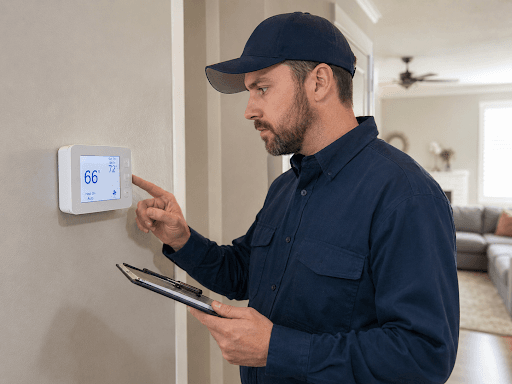
The important thing is not to keep lowering or raising the temperature and hoping the system catches up. A thermostat only tells your HVAC system what to do. If the equipment cannot respond properly, the number on the screen will not match how your home actually feels.
This guide walks through the most common reasons this happens, what you can safely check yourself, and when it is time to call Raymoore Heating and Cooling for professional HVAC troubleshooting.
What should you check before assuming your thermostat is broken?
1. Check the thermostat mode
Make sure the thermostat is set to the right mode. Choose “Heat” when you want the home warmer and “Cool” when you want air conditioning. If it is set to “Off,” “Fan,” or the wrong seasonal mode, your HVAC system may not respond the way you expect.
2. Look at the temperature setting
Confirm that the set temperature is actually higher or lower than the current room temperature. For heating, the set temperature needs to be above the current indoor temperature. For cooling, it needs to be below it.
3. Review the schedule
Programmable and smart thermostats may follow a schedule even after you manually change the temperature. Check for weekday settings, weekend settings, vacation mode, away mode, eco mode, or app-based controls that may be overriding your preferred temperature.
4. Check the batteries
If your thermostat uses batteries, weak power can cause a dim screen, delayed response, incorrect readings, or lost settings. Replace the batteries and give the thermostat a few minutes to reconnect with the system.
5. Inspect the breaker and system switch
If the thermostat is blank or the HVAC system does not turn on, check the breaker panel and the power switch near the furnace or air handler. A tripped breaker or switched-off system can make it seem like the thermostat is the problem.
6. Make sure the fan setting is correct
The fan setting can affect how your home feels. “Auto” means the fan runs only when the system is actively heating or cooling. “On” keeps the fan running continuously, which may circulate air even when the system is not changing the temperature.
7. Give the system time to respond
After changing the temperature, wait a few minutes. Some systems have built-in delay settings to protect the equipment from short cycling. If nothing happens after several minutes, or the system runs but never reaches the set temperature, the issue may need professional HVAC troubleshooting.
How can poor airflow stop your home from reaching the temperature you set?
Poor airflow is one of the most common reasons a thermostat never seems satisfied. Your HVAC system may be running, but if air is not moving properly through the home, the temperature will change slowly or unevenly.
A dirty air filter is usually the first thing to check. When a filter becomes clogged, your system has to work harder to pull air through it. That can reduce comfort, increase energy use, and put extra strain on the equipment. During heavy heating or cooling seasons, filters should be checked regularly and replaced when dirty.
Walk through your home and look at the vents, too. Make sure supply vents are open and not covered by furniture, rugs, curtains, or boxes. Return vents also need space around them so air can circulate back to the system.
If some rooms feel comfortable while others stay too hot or too cold, the thermostat may not be the real problem. You could be dealing with weak airflow, leaky ducts, a blower issue, or poor system balance. Raymoore Heating and Cooling can inspect these problems through professional HVAC repair services.
Why does thermostat location matter so much?
Your thermostat responds to the temperature around it, not the temperature in every room. That means placement can have a big effect on how your system runs.
If the thermostat is near a sunny window, exterior door, kitchen, fireplace, lamp, supply vent, or drafty hallway, it may read the temperature incorrectly. For example, direct sunlight can make the thermostat think the house is warmer than it really is. A nearby vent can make it think the room reached the set temperature too quickly.
A good thermostat location is usually on an interior wall, away from drafts, heat sources, and direct sunlight. If your thermostat has always seemed inaccurate, placement may be part of the issue.
You can do a simple test by placing a reliable room thermometer near the thermostat for about 15 to 20 minutes. If the readings are noticeably different, the thermostat may need recalibration, cleaning, relocation, or replacement.
Thermostat set correctly but your home still won’t reach the right temperature?
Raymoore Heating and Cooling can inspect your thermostat, airflow, wiring, and HVAC system to find the real cause before the problem gets worse. We help homeowners across Indianapolis, Greenwood, Shelbyville, and nearby Central Indiana communities restore steady, reliable comfort. Schedule Your Thermostat and HVAC Inspection Today.
What are the signs that the thermostat itself may be the problem?
A thermostat may be failing if the screen goes blank, buttons do not respond, settings reset on their own, or the system does not turn on when it should. Another warning sign is short cycling, which happens when the HVAC system turns on and off too frequently.
Incorrect temperature readings can also point to thermostat trouble. If the thermostat says the room is 72 degrees but it clearly feels much warmer or colder, the sensor may be dirty, poorly calibrated, or wearing out.
That said, thermostat symptoms can be misleading. A thermostat may be sending the right signal, but the HVAC equipment may not be able to respond. This is why it is helpful to look at both the thermostat and the system before replacing anything.
Could the HVAC system be the real reason your home is not comfortable?
Yes. Sometimes the thermostat is working exactly as it should, but the furnace, air conditioner, or heat pump cannot keep up.
If your AC is running but the house is not cooling, the issue may involve low refrigerant, a dirty evaporator coil, a weak capacitor, a failing compressor, or restricted airflow. If your heating system is running but the house stays cold, the problem may involve ignition, burners, a flame sensor, safety controls, or heat pump performance.
Age can also play a role. Older HVAC systems may run longer and still fail to deliver consistent comfort. If your system needs frequent repairs, struggles during extreme weather, or causes rising energy bills, it may be time to compare repair costs with replacement options.
Raymoore Heating and Cooling offers HVAC upgrade and replacement services for homeowners who want a clearer answer on whether repairing or replacing their system makes the most sense.
When should you call an HVAC technician?
Call a technician if you have checked the thermostat settings, batteries, breaker, filter, and vents but your home still will not reach the set temperature. You should also schedule service if the system runs constantly, shuts off too quickly, blows the wrong temperature air, trips the breaker, or makes unusual noises.
Thermostat wiring is another reason to bring in a professional. Loose wires, low-voltage issues, corroded connections, and control board problems can prevent the thermostat and HVAC equipment from communicating properly.
For homeowners, Raymoore’s HVAC repair team can inspect the thermostat, wiring, airflow, system performance, and equipment condition. For business owners, Raymoore also provides commercial HVAC services for temperature control issues in offices, retail spaces, facilities, and other commercial buildings.
How does regular maintenance help prevent thermostat problems?
Regular maintenance helps catch small problems before they affect comfort. A tune-up can reveal dirty coils, weak airflow, loose electrical connections, refrigerant problems, thermostat calibration issues, and worn parts.
This is especially important in Central Indiana, where HVAC systems have to handle humid summers, cold winters, and quick temperature swings. When your system is clean, properly adjusted, and running efficiently, it has a much better chance of reaching the temperature you set.
Raymoore Heating and Cooling provides preventative maintenance services for furnaces, air conditioners, heat pumps, and air handlers. Homeowners who want routine seasonal care can also ask about HVAC service agreements, which include scheduled tune-ups and priority service.
FAQ
Why is my thermostat set to 72 but my house stays at 78?
This usually means your cooling system cannot remove heat fast enough. The cause may be a dirty filter, blocked vents, low refrigerant, poor airflow, duct leakage, thermostat placement, or an AC system that is struggling during hot weather.
Can a dirty air filter keep my home from reaching the set temperature?
Yes. A dirty filter restricts airflow, which makes it harder for your HVAC system to heat or cool your home. It can also make the system run longer than normal.
Should I reset my thermostat?
A reset may help if the thermostat is frozen, unresponsive, or following the wrong schedule. After resetting it, check the mode, temperature hold, Wi-Fi settings, and programmed schedule.
Is it normal for my HVAC system to run longer during extreme weather?
It can be normal for the system to run more often during very hot or very cold weather. However, if it never reaches the set temperature, there may be an airflow, equipment, ductwork, or thermostat issue that needs attention.
Does replacing the thermostat always fix the problem?
No. Replacing the thermostat only helps if the thermostat is actually the problem. If the HVAC system has airflow issues, low refrigerant, duct leaks, wiring problems, or aging equipment, a new thermostat will not solve the comfort issue.
A More Comfortable Home Starts With the Right Diagnosis
When your thermostat is not reaching the set temperature, it is tempting to keep adjusting the number on the screen. But the better move is to find out why your home is not responding.
Start with the easy checks: mode, schedule, batteries, breaker, filter, and vents. If everything looks normal and your home still feels uncomfortable, Raymoore Heating and Cooling can help identify whether the issue is with the thermostat, airflow, wiring, ductwork, or HVAC equipment.
To schedule service, contact Raymoore Heating and Cooling through the contact page or call 317-418-2961.
Why Raymoore Heating and Cooling is Your Ideal Choice for Thermostat Troubleshooting?
Raymoore Heating and Cooling knows that thermostat issues are not always simple. A home may have a thermostat problem, an airflow problem, an equipment problem, or a combination of all three. Their team takes a full-system approach so homeowners are not left guessing or replacing parts that do not solve the real issue.
With experience serving Indianapolis, Greenwood, Shelbyville, Franklin, Southport, and nearby Central Indiana communities, Raymoore understands the comfort challenges local homes face throughout the year. Whether you need a thermostat repair, seasonal tune-up, emergency HVAC service, or new HVAC installation, their team can help you choose the right next step.
Schedule Thermostat and HVAC Service With Raymoore Heating and Cooling
If your home is not reaching the temperature you set, Raymoore Heating and Cooling can help restore comfort with honest troubleshooting and dependable HVAC service. Schedule an appointment today and get your home back to feeling the way it should.